About 594 minutes
The English works of Thomas Hobbes of Malmesbury, Volume 04 (of 11) — Text and Context
Ethics
136,612 recorded words. 3 minutes difference from this book's estimate.
View Gutenberg source #74236
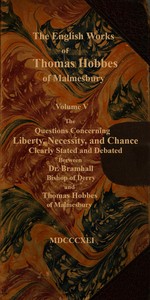
Before opening The English works of Thomas Hobbes of Malmesbury, Volume 05 (of 11) — Themes and Context, the edition data offers a quick orientation: 137,186 words, 9 hr 57 min estimated reading time, and 18 detected text sections.
The text analysis averages about 26.8 words per sentence, while the detected sections provide another way to judge how the source is divided.
Project Gutenberg metadata also associates the work with “Philosophy, English -- 17th century,” connecting these edition facts with the source record’s subject description.
Explore this collection
These alternatives are selected using recorded categories and estimated reading time.
About 594 minutes
Ethics
136,612 recorded words. 3 minutes difference from this book's estimate.
View Gutenberg source #74236About 590 minutes
Ethics
135,471 recorded words. 7 minutes difference from this book's estimate.
View Gutenberg source #46884About 605 minutes
Ethics
139,110 recorded words. 8 minutes difference from this book's estimate.
View Gutenberg source #53791Search stored excerpts and compare books → Choose by your preferences →
Choices use stored catalog measurements. Estimates vary with reading speed. A shared category is a catalog label, not a claim that two books have the same argument or literary quality.
Search reads excerpt text stored with this catalog and links to its associated Gutenberg record. The connection is stored in the site database; this tool does not recheck that every excerpt is word-for-word identical to that external record. Excerpt search does not cover every chapter and does not verify historical publication dates.
Catalog snapshot checked: 2026-09-25. Coverage: 92 public books, 92 available source excerpts.
Calculated from edition completeness, EPUB availability, text structure and catalogue metadata. Not a user rating.
Total of 100 points, scaled to a 2.5-5.0 range. Editions with an empty description or a missing EPUB file are not scored.
Public-domain source text
The source text is kept in the dedicated reader, separate from this catalogue record and its commentary.
This volume presents Thomas Hobbes's extended debate with John Bramhall, Bishop of Derry, on the questions of liberty, necessity, and chance. The text is structured as a point-by-point rebuttal, with Hobbes directly quoting and then dismantling Bramhall's arguments. Hobbes's prose is characteristically blunt: he dismisses Bramhall's notion of the will's self-determination as 'nonsense' and repeatedly insists that the only liberty a man has is to do as he wills, not to will as he pleases. The excerpts show Hobbes carefully parsing distinctions between law, justice, and divine causation, often accusing his opponent of logical errors or misrepresentations.
Hobbes and Bramhall agree on one point: men are free to do as they will and to forbear as they will. The disagreement lies in what controls the will itself. Bramhall argues that the will can choose what it shall will, a position Hobbes treats as incoherent. Hobbes's method is to reduce Bramhall's claims to absurdity: if the will determines itself freely, he asks, what does that mean? He finds no meaning. The exchange reveals Hobbes's commitment to a deterministic universe where every event has a necessary cause, and chance produces nothing. Bramhall, by contrast, insists on contingency and a will that can act without prior determination. The debate thus hinges on definitions of freedom, necessity, and cause.
Hobbes does not merely argue; he attacks. He accuses Bramhall of misrepresenting his views, as when Bramhall claims Hobbes says the law enjoins things impossible in themselves. Hobbes retorts that he said no such thing: the law may enjoin things made impossible by secret causes, but not contradictions. He also rejects Bramhall's use of the word 'influence' as senseless. Throughout, Hobbes employs a strategy of redefinition: he insists that liberty is simply the absence of external impediments to action, not any power in the will. When Bramhall appeals to a judge's duty to consider all causes, Hobbes counters that a judge looks only at the will of the doer, not at the hidden chain of necessity. This practical orientation grounds his abstract philosophy in legal and everyday reasoning.
A central tension in the debate is the relationship between God's will and human action. Hobbes holds that the will of God makes all things necessary, but he denies that this makes human will merely God's will. Instead, he speaks of 'subjection of the will of man to the will of God,' a relation of hierarchy, not identity. Bramhall, by contrast, argues that God's will concurs with human will only when the action is good, leaving room for human autonomy. Hobbes finds this position inconsistent with divine omnipotence. The excerpts show Hobbes grappling with the implications of his determinism for moral responsibility: if all actions are necessary, can they be justly punished? His answer is that the law punishes voluntary actions, and the will is a sufficient cause for the judge, regardless of its own causes.
Readers approaching this volume should attend to Hobbes's relentless focus on linguistic precision. He repeatedly charges Bramhall with using meaningless phrases, and his own prose is a model of clarity—if not always of charity. The debate is not merely philosophical but rhetorical: each man tries to force the other into contradiction. Hobbes's strategy is to deny the very terms of Bramhall's argument, insisting that free will, as Bramhall defines it, is a fiction. This volume offers a front-row seat to a foundational dispute in early modern philosophy, one that continues to shape discussions of determinism and moral responsibility.
That rainy afternoon, Hobbes’s relentless dismantling of Bramhall’s free will left me feeling oddly unsettled, as if choice itself were a comforting illusion. I set the book down, and my gaze drifted to another volume on the shelf, The Royal Exchange and the Palace of Industry; or, The Possible Future of Europe and the World — Context and Discussion, whose promises of grand human projects suddenly seemed like a hopeful counterpoint to all that determinism.
A brief reflection can help important ideas stay with you longer.