About 597 minutes
The English works of Thomas Hobbes of Malmesbury, Volume 05 (of 11) — Themes and Context
Ethics
137,186 recorded words. 8 minutes difference from this book's estimate.
View Gutenberg source #76650
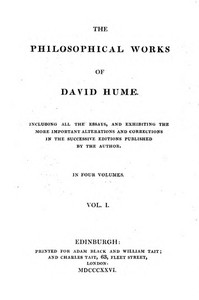
Before opening Philosophical Works, v. 1 (of 4) Including All the Essays, and Exhibiting the More Important Alterations and Corrections in the Successive Editions Published by the — Story, Setting & Ideas, the edition data offers a quick orientation: 139,110 words, 10 hr 5 min estimated reading time, and 16 detected text sections.
The text analysis averages about 25.7 words per sentence, while the detected sections provide another way to judge how the source is divided.
Project Gutenberg metadata also associates the work with “Knowledge, Theory of,” connecting these edition facts with the source record’s subject description.
Explore this collection
These alternatives are selected using recorded categories and estimated reading time.
About 597 minutes
Ethics
137,186 recorded words. 8 minutes difference from this book's estimate.
View Gutenberg source #76650About 594 minutes
Ethics
136,612 recorded words. 11 minutes difference from this book's estimate.
View Gutenberg source #74236About 590 minutes
Ethics
135,471 recorded words. 15 minutes difference from this book's estimate.
View Gutenberg source #46884Search stored excerpts and compare books → Choose by your preferences →
Choices use stored catalog measurements. Estimates vary with reading speed. A shared category is a catalog label, not a claim that two books have the same argument or literary quality.
Search reads excerpt text stored with this catalog and links to its associated Gutenberg record. The connection is stored in the site database; this tool does not recheck that every excerpt is word-for-word identical to that external record. Excerpt search does not cover every chapter and does not verify historical publication dates.
Catalog snapshot checked: 2026-09-25. Coverage: 92 public books, 92 available source excerpts.
Calculated from edition completeness, EPUB availability, text structure and catalogue metadata. Not a user rating.
Total of 100 points, scaled to a 2.5-5.0 range. Editions with an empty description or a missing EPUB file are not scored.
Public-domain source text
The source text is kept in the dedicated reader, separate from this catalogue record and its commentary.
The 1825 edition of David Hume's Philosophical Works, volume one, presents a text that is as much about editorial intervention as it is about Hume's own arguments. The editor's Advertisement announces a policy of collating earlier editions and recording 'the successive variations of sentiment and taste' in footnotes, marking 'the gradual and most observable increase of caution' in Hume's expression. This apparatus transforms the reading experience: the reader is never allowed to forget that the words on the page are the product of a specific historical moment and a deliberate process of revision.
The catalog subject 'Philosophy, English -- 18th century' might suggest a direct encounter with Hume's thought, but the editor's presence complicates that. The Advertisement explains that the text follows the 1777 edition 'corrected by the Author for the press, a short time before his death,' yet the editor also inserts notes from earlier editions to show 'the more important alterations and corrections.' This means the reader is constantly comparing versions, not simply absorbing a final statement. The editor even includes a list of collated editions, from 1741 onward, turning the volume into a textual laboratory. For instance, the excerpt from Section IX contains no footnote in the provided text, but the editor's promise of notes for 'not merely verbal' changes suggests that elsewhere the reader must weigh variant phrasings. This editorial framing aligns with the catalog's 'Knowledge, Theory of' by making the process of textual transmission itself a subject of inquiry.
The excerpt from Section IX of the Treatise reveals Hume's method of building arguments through systematic relations. He explicitly names 'resemblance and contiguity' as 'associating principles of thought' alongside cause and effect. The passage then tests whether belief can arise from all three relations, only to conclude from experience that 'belief arises only from causation.' This is not a casual observation; Hume structures his reasoning as a self-correcting loop. He presents an objection, then offers a solution, using terms like 'system' and 'reality' with deliberate precision. The mind, he writes, forms 'a kind of system' from memory and senses, and another from judgment, which 'peoples the world.' This vocabulary of system-building is central to Hume's epistemology and directly supports the catalog subject 'Knowledge, Theory of.' The reader sees Hume not merely stating conclusions but demonstrating how philosophical inquiry proceeds by turning the subject 'on every side.'
The editor's note about 'increase of caution' in Hume's expression finds a counterpart in the excerpt's own rhetoric. Hume begins Section IX by calling a 'scrupulous hesitation to receive any new hypothesis' a 'laudable disposition in philosophers.' Yet he also asserts his principles as 'extraordinary and such fundamental principles.' This tension between caution and confidence runs through the passage. He uses first-person constructions ('I have often observed,' 'I paint the universe in my imagination') that personalize the argument, while simultaneously appealing to 'experience' and 'the mind' as universal authorities. The catalog subject 'Philosophy, English -- 18th century' often emphasizes Hume's skepticism, but here the rhetoric is more balanced: he is both the cautious inquirer and the confident system-builder. The editor's apparatus, by highlighting changes across editions, reinforces this duality, showing that Hume's caution was itself a developing trait.
Readers approaching this volume should attend to the footnotes and the editor's preface as integral parts of the work. The catalog subjects provide a starting point, but the excerpts show that Hume's theory of knowledge is inseparable from his method of argument and the textual history that shaped it. Comparing the 1825 text with earlier editions—if accessible—can reveal how Hume's philosophical positions evolved, but even within this single volume, the interplay between the editor's apparatus and Hume's prose offers a richer understanding of eighteenth-century philosophical practice.
There’s something tender about watching Hume trace his own revisions, the way he keeps rethinking what he meant by “system.” It reminded me of sitting with The Greek Philosophers, Vol. 1 (of 2) — A Closer Reading, where the old thinkers feel less like monuments and more like friends still working things out. That lingering ache of unfinished thought stayed with me.
Create a short personal record of your experience with this book.