About 597 minutes
The English works of Thomas Hobbes of Malmesbury, Volume 05 (of 11) — Themes and Context
Ethics
137,186 recorded words. 3 minutes difference from this book's estimate.
View Gutenberg source #76650
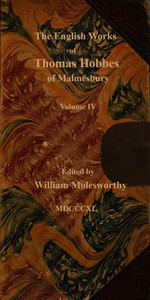
For The English works of Thomas Hobbes of Malmesbury, Volume 04 (of 11) — Text and Context, the stored edition analysis reports 136,612 words, 9 hr 54 min estimated reading time, and 23 detected text sections.
The text analysis averages about 28.7 words per sentence, while the detected sections provide another way to judge how the source is divided.
Project Gutenberg metadata also associates the work with “Philosophy, English -- 17th century,” connecting these edition facts with the source record’s subject description.
Explore this collection
These alternatives are selected using recorded categories and estimated reading time.
About 597 minutes
Ethics
137,186 recorded words. 3 minutes difference from this book's estimate.
View Gutenberg source #76650About 590 minutes
Ethics
135,471 recorded words. 4 minutes difference from this book's estimate.
View Gutenberg source #46884About 589 minutes
Ethics
135,467 recorded words. 5 minutes difference from this book's estimate.
View Gutenberg source #56822Search stored excerpts and compare books → Choose by your preferences →
Choices use stored catalog measurements. Estimates vary with reading speed. A shared category is a catalog label, not a claim that two books have the same argument or literary quality.
Search reads excerpt text stored with this catalog and links to its associated Gutenberg record. The connection is stored in the site database; this tool does not recheck that every excerpt is word-for-word identical to that external record. Excerpt search does not cover every chapter and does not verify historical publication dates.
Catalog snapshot checked: 2026-09-25. Coverage: 92 public books, 92 available source excerpts.
Calculated from edition completeness, EPUB availability, text structure and catalogue metadata. Not a user rating.
Total of 100 points, scaled to a 2.5-5.0 range. Editions with an empty description or a missing EPUB file are not scored.
Public-domain source text
The source text is kept in the dedicated reader, separate from this catalogue record and its commentary.
Volume IV of Sir William Molesworth's edition of Hobbes's English works opens with the Tripos, a trilogy that Hobbes himself likened to Euclid's sequence: each part builds on the preceding. The first discourse, Human Nature, begins with a reader's address that insists on a demonstrative method—'such philosophical principles, as are not commonly known or asserted'—and proceeds by numbered definitions. Yet the volume also contains pieces where Hobbes abandons this geometric tone for direct polemic, as in his answer to Bishop Bramhall, where the language turns combative and personal.
In the Tripos, Hobbes repeatedly frames his argument as a chain of definitions and deductions. The preface to Human Nature declares that the work follows the order 'used by men conversant in demonstration,' and the text is structured accordingly: numbered sections, each building on the last. Yet even within this rigid framework, Hobbes's prose occasionally shifts. In Of Liberty and Necessity, the opening address to the 'sober and discreet reader' employs a more elaborate, almost sermonic rhythm—long periodic sentences that contrast with the clipped definitions of the earlier discourses. This variation suggests that Hobbes tailored his voice to the controversy at hand, reserving the geometric style for foundational political theory and adopting a more rhetorical register when engaging theological opponents.
The Answer to Bishop Bramhall's Book marks a clear departure from the Tripos's measured exposition. Here Hobbes's sentences grow shorter, his tone sharper. He repeatedly interrupts his own argument with direct addresses to Bramhall, using phrases like 'you say' and 'I answer.' The syntax becomes more paratactic—clauses strung together without subordination—as if mimicking the cut-and-thrust of oral debate. This change in pace is not merely stylistic; it reflects Hobbes's strategic choice to meet his opponent on the ground of immediate refutation rather than systematic demonstration. The result is a text that feels more urgent, less patient, than the earlier works in the volume.
The Historical Narration concerning Heresy introduces yet another voice: that of the chronicler. Hobbes here adopts a plain, sequential style, tracing the term 'heresy' from its Greek origins through early church councils. The sentences are shorter and more factual, with fewer logical connectives than in the Tripos. This shift in register is significant: Hobbes is not demonstrating a system but constructing a historical argument, and his prose adapts accordingly. The narrative pace is steady, almost annalistic, allowing the reader to follow the evolution of the concept without the dense chains of reasoning that characterize the political works. This variety within a single volume underscores Hobbes's versatility as a writer, moving from geometric deduction to polemic to history with distinct linguistic tools for each.
Readers approaching this volume should attend to how Hobbes modulates his voice across the seven works collected here. The Tripos rewards those who follow its stepwise logic; the later pieces demand a different kind of attention, one alert to rhetorical thrust and historical context. Noticing these shifts in pace and register enriches the reading of any single text, revealing Hobbes as a writer who adapted his style to his purpose and audience.
Across my years at this desk, I've watched Hobbes in his fifties turn from cold axioms toward quarrel—yet that restless motion always circled one hunger: certainty, however stubbornly held. Beside him rests The will to doubt — Themes and Context, its pages wearing a gentler skepticism, almost a sigh after his hammering. They share a quiet kinship, like two old readers who each found different doors to the same dark room.
Create a short personal record of your experience with this book.