About 662 minutes
The Greek Philosophers, Vol. 2 (of 2) — Themes and Context
Ethics
152,079 recorded words. 75 minutes difference from this book's estimate.
View Gutenberg source #58224
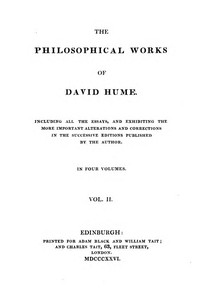
Philosophical Works, v. 2 (of 4) Including All the Essays, and Exhibiting the More Important Alterations and Corrections in the Successive Editions Published by the — Key Ideas to Explore can be approached with a clearer sense of reading commitment from its source measurements: 169,286 words, 12 hr 17 min estimated reading time, and 19 detected text sections.
The text analysis averages about 26.4 words per sentence, while the detected sections provide another way to judge how the source is divided.
Project Gutenberg metadata also associates the work with “Knowledge, Theory of,” connecting these edition facts with the source record’s subject description.
Explore this collection
These alternatives are selected using recorded categories and estimated reading time.
About 662 minutes
Ethics
152,079 recorded words. 75 minutes difference from this book's estimate.
View Gutenberg source #58224About 638 minutes
Ethics
146,554 recorded words. 99 minutes difference from this book's estimate.
View Gutenberg source #57126About 850 minutes
Ethics
195,470 recorded words. 113 minutes difference from this book's estimate.
View Gutenberg source #29412Search stored excerpts and compare books → Choose by your preferences →
Choices use stored catalog measurements. Estimates vary with reading speed. A shared category is a catalog label, not a claim that two books have the same argument or literary quality.
Search reads excerpt text stored with this catalog and links to its associated Gutenberg record. The connection is stored in the site database; this tool does not recheck that every excerpt is word-for-word identical to that external record. Excerpt search does not cover every chapter and does not verify historical publication dates.
Catalog snapshot checked: 2026-09-25. Coverage: 92 public books, 92 available source excerpts.
Calculated from edition completeness, EPUB availability, text structure and catalogue metadata. Not a user rating.
Total of 100 points, scaled to a 2.5-5.0 range. Editions with an empty description or a missing EPUB file are not scored.
Public-domain source text
The source text is kept in the dedicated reader, separate from this catalogue record and its commentary.
David Hume's Treatise of Human Nature, Books II and III, as presented in this volume, shows a philosopher committed to breaking down mental life into its simplest components. The opening division of perceptions into impressions and ideas, and impressions into original and secondary, sets a pattern of careful taxonomy that recurs throughout. Hume's prose is direct, often conversational, yet rigorously analytical. He builds arguments by posing questions, anticipating objections, and testing his principles against common experience. The excerpts on promises, for instance, illustrate his method: he denies any natural motive to keep promises apart from a sense of duty, then challenges dissenters to prove otherwise. This combination of clarity and provocation is characteristic of Hume's authorial voice.
Hume's diction is marked by a preference for binary divisions and precise distinctions. In the first section of Book II, he divides perceptions into impressions and ideas, then impressions into original and secondary. This habit of splitting concepts into pairs recurs: pride and humility, love and hatred, natural and artificial virtues. The vocabulary is plain—'objects,' 'causes,' 'relations,' 'influence'—but each term is carefully defined. Hume often uses the phrase 'we must consider' to signal a new analytical step. His sentences are typically short and declarative, avoiding ornate rhetoric. For example, he writes, 'Men being naturally selfish, or endowed only with a confined generosity,' a statement that combines a claim about human nature with a qualification that limits its scope. This precision in wording allows him to build complex arguments from simple building blocks.
Hume frequently challenges his readers or hypothetical opponents with direct demands for proof. In the discussion of promises, he writes, 'If any one dissent from this, he must give a regular proof of these two propositions.' This rhetorical move—posing a challenge and then asserting its impossibility—is a hallmark of his style. He uses the first-person plural ('we,' 'our') to create a sense of shared inquiry, but also shifts to the impersonal ('it is evident,' 'it follows') when stating conclusions. The excerpts show a pattern: Hume states a position, anticipates an objection, and then refutes it by appealing to experience or logical consistency. For instance, he argues that if no human had a natural inclination to care for children, no one could be obligated to do so—a claim that ties moral obligation to observable human sentiments. This interplay of assertion and challenge gives the text a dynamic, almost dialogic quality.
Throughout the excerpts, Hume grounds his moral philosophy in empirical observations about human nature. He repeatedly refers to 'the natural course of our passions and inclinations' and 'the same qualities of human nature' that give rise to laws of society. His diction emphasizes limitation: humans are 'naturally selfish,' endowed with 'confined generosity,' and 'very limited in our kindness and affection.' These are not value judgments but descriptive claims. Hume uses them to explain why artificial institutions like promises and government are necessary. The word 'natural' appears frequently but with shifting meanings: natural virtues arise from innate sentiments, while artificial virtues depend on human conventions. This careful distinction between what is innate and what is invented is central to his argument. The excerpts show him tracing the origin of justice, property, and promises back to 'necessities and interests,' a move that grounds morality in practical human needs rather than abstract reason.
Hume's argumentative structure relies on repetition and cumulative reasoning. He often restates a principle in slightly different terms, as when he says promises are 'human inventions, founded on the necessities and interests of society' after having argued that they have no natural motive. This repetition reinforces his points without becoming tedious. The table of contents reveals a systematic organization: each part is divided into sections that build on previous ones. Within sections, Hume uses numbered points or logical steps ('First,' 'Now,' 'But'). The excerpts show him moving from general principles to specific applications, then back to broader reflections. For example, after discussing the origin of promises, he considers the 'mutual commerce of good offices' and how it is 'lost among mankind' without conventions. This structural clarity helps readers follow his intricate arguments. The volume's inclusion of variant readings from successive editions allows one to see how Hume refined his wording over time, often sharpening a phrase or adding a qualification.
Readers approaching this volume should attend to Hume's method as much as his conclusions. His arguments are built from small, precise observations about human psychology and social life. The variant readings included here offer a rare opportunity to see a philosopher at work, adjusting his language to achieve greater clarity or force. Whether one agrees with Hume or not, the care with which he constructs his case—the divisions, the challenges, the appeals to common experience—makes this a model of philosophical writing. It rewards slow, attentive reading.
Hume’s way of tracing our passions and beliefs to their quiet, ordinary roots stayed with me long after I set the book down. It felt like sitting with a friend who notices how we really behave. That same gentle observation of human nature, the everyday mechanics of trust and reputation, lingers in The business career in its public relations — Text and Context. It made me think of how we shape ourselves for others, almost without noticing.
A brief reflection can help important ideas stay with you longer.