About 444 minutes
The Ethics of Drink and Other Social Questions; Or, Joints In Our Social Armour — Reading Notes
Political Philosophy
102,113 recorded words. 19 minutes difference from this book's estimate.
View Gutenberg source #13365
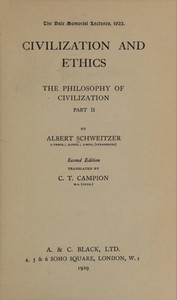
The catalog record for Civilization and ethics — A Reader’s Guide provides practical reading context through 106,408 words, 7 hr 43 min estimated reading time, and 14 detected text sections.
The text analysis averages about 23.7 words per sentence, while the detected sections provide another way to judge how the source is divided.
Project Gutenberg metadata also associates the work with “Ethics,” connecting these edition facts with the source record’s subject description.
Explore this collection
These alternatives are selected using recorded categories and estimated reading time.
About 444 minutes
Political Philosophy
102,113 recorded words. 19 minutes difference from this book's estimate.
View Gutenberg source #13365About 442 minutes
Political Philosophy
101,476 recorded words. 21 minutes difference from this book's estimate.
View Gutenberg source #63249About 430 minutes
Political Philosophy
98,740 recorded words. 33 minutes difference from this book's estimate.
View Gutenberg source #68687Search stored excerpts and compare books → Choose by your preferences →
Choices use stored catalog measurements. Estimates vary with reading speed. A shared category is a catalog label, not a claim that two books have the same argument or literary quality.
Search reads excerpt text stored with this catalog and links to its associated Gutenberg record. The connection is stored in the site database; this tool does not recheck that every excerpt is word-for-word identical to that external record. Excerpt search does not cover every chapter and does not verify historical publication dates.
Catalog snapshot checked: 2026-09-25. Coverage: 92 public books, 92 available source excerpts.
Calculated from edition completeness, EPUB availability, text structure and catalogue metadata. Not a user rating.
Total of 100 points, scaled to a 2.5-5.0 range. Editions with an empty description or a missing EPUB file are not scored.
Public-domain source text
The source text is kept in the dedicated reader, separate from this catalogue record and its commentary.
Schweitzer opens by declaring his subject “the tragedy of the Western world-view.” He recounts how, as a student, he noticed that the history of thought was written as a history of philosophical systems, not as a history of man’s effort to arrive at a world-view. This observation drives his unsparing reckoning with Western thought: it sought a world- and life-affirming ethical foundation for civilization, but never succeeded in grounding it convincingly. Instead, philosophy produced “unstable fragments” and became captive to secondary, academic questions. Schweitzer’s diagnosis is blunt: philosophy offered “bandmaster’s music” instead of real music.
Schweitzer charges that Western philosophy lost connection with the elementary questions that man must ask of life and the world. It found satisfaction in handling merely academic questions and in mastering philosophical technique. The result was a philosophy that “did nothing but philosophize” instead of struggling for a world-view grounded in thought. This failure, he argues, made civilization itself fragmentary and insecure. The language is striking: philosophy produced “again and again mere bandmaster’s music, often magnificent stuff of its kind, but still only bandmaster’s music.” The metaphor suggests technical proficiency without genuine substance—a performance that impresses but does not nourish.
Schweitzer’s critique of Hegel is detailed and pointed. He notes that Hegel wrote no treatise on ethics; what he published on ethics appears in his philosophy of law. For Hegel, the State is “the self-conscious moral substance,” and the most valuable in the moral comes to actuality in and through it. Schweitzer sees this as an overvaluing of the State, a consequence of Hegel’s low valuation of the spiritual significance of individuality. Hegel refuses ethics the liberty to be conceived as a relation of the individual to the universe; instead, ethics are restricted to regulating relations between individuals and society. They are “simply built into the edifice as an already shaped and dressed stone.”
Schweitzer draws a remarkable analogy between Hegel’s thought and Brahmanic philosophy. Both, he argues, allow ethics only a preparatory role: with the Brahmans, ethics prepare the individual for an intellectual act of experiencing the Absolute; with Hegel, they help form the society in which the Absolute experiences itself. The inner similarity is that both give value to ethics only as a phase of intellectuality. Schweitzer insists that in neither system are ethics shown to be necessary. For Hegel, society could come into existence by law alone, making his ethic “only a species of law.” The comparison is not flattering: it exposes a deep intellectualism that subordinates ethical life to a higher, non-ethical end.
Schweitzer’s argument demands that the reader reconsider what philosophy ought to do. He does not offer a solution here; instead, he lays bare a pattern of evasion and intellectualism that he believes has crippled Western civilization. Readers should attend to his recurring metaphors—bandmaster’s music, dressed stone, colouring—as clues to his method. The book is a diagnosis, not a prescription, and its force lies in the precision of its accusations.
I remember sitting with Schweitzer’s grief over Hegel’s tidy system—how ethics dissolved into the State’s machinery, like Brahmanic air. It felt like watching a friend’s faith quietly crack. Later, The Philosophical Theory of the State — Key Ideas to Explore offered a gentler echo of that ache, a map of the same precarious ledge. Both left me less certain, but oddly warmer toward what remains.
Capture what you thought, learned, and would like to remember.