About 40 minutes
Morals in Trade and Commerce — Themes and Context
Ethics
8,991 recorded words. 0 minutes difference from this book's estimate.
View Gutenberg source #29276
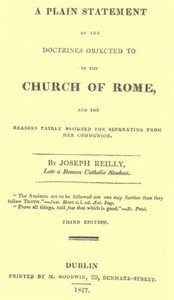
Before opening A Plain Statement of the Doctrines Objected to in the Church of Rome And the Reasons Fairly Assigned for Separating From Her Communion — Context and Discussion, the edition data offers a quick orientation: 9,105 words, 40 min estimated reading time, and 1 detected text section.
The text analysis averages about 29.8 words per sentence, while the detected sections provide another way to judge how the source is divided.
Project Gutenberg metadata also associates the work with “Catholic Church -- Controversial literature,” connecting these edition facts with the source record’s subject description.
Explore this collection
These alternatives are selected using recorded categories and estimated reading time.
About 40 minutes
Ethics
8,991 recorded words. 0 minutes difference from this book's estimate.
View Gutenberg source #29276About 35 minutes
Ethics
7,914 recorded words. 5 minutes difference from this book's estimate.
View Gutenberg source #34085About 47 minutes
Ethics
10,593 recorded words. 7 minutes difference from this book's estimate.
View Gutenberg source #69614Search stored excerpts and compare books → Choose by your preferences →
Choices use stored catalog measurements. Estimates vary with reading speed. A shared category is a catalog label, not a claim that two books have the same argument or literary quality.
Search reads excerpt text stored with this catalog and links to its associated Gutenberg record. The connection is stored in the site database; this tool does not recheck that every excerpt is word-for-word identical to that external record. Excerpt search does not cover every chapter and does not verify historical publication dates.
Catalog snapshot checked: 2026-09-25. Coverage: 92 public books, 92 available source excerpts.
Calculated from edition completeness, EPUB availability, text structure and catalogue metadata. Not a user rating.
Total of 100 points, scaled to a 2.5-5.0 range. Editions with an empty description or a missing EPUB file are not scored.
Public-domain source text
The source text is kept in the dedicated reader, separate from this catalogue record and its commentary.
Joseph Reilly opens his 1827 tract with a personal account of his departure from the Church of Rome, framing it as a conscientious decision reached after repeated private and public interviews with his pastor. The work is structured as a sequential argument: Reilly first narrates his background and the failure of clerical explanations to satisfy his doubts, then moves through specific doctrines he finds unsupported by Scripture. The text alternates between autobiographical passages and direct appeals to the reader, punctuated by quotations from Catholic prayer books such as the Key of Paradise and the Poor Man's Manual. Reilly's recurring image is that of a troubled conscience seeking scriptural warrant, and he repeatedly contrasts the authority of the Bible with what he calls 'tradition and the assertions of interested men.'
Reilly begins by describing his upbringing under his uncle, a Roman Catholic priest, and his subsequent efforts to enter Maynooth College. The narrative is built around a series of meetings with his pastor, each intended to resolve his doubts but instead deepening them. Reilly notes that the pastor eventually admitted he could not satisfy him, a moment that Reilly presents as a turning point. This section establishes the work's structure as a testimony: the author's personal experience serves as evidence for his later doctrinal arguments. The language is direct and defensive, as Reilly anticipates accusations of inconsistency or malice. He repeatedly emphasizes that he sought to quiet his 'anxious mind' and 'troubled conscience' before taking any step, framing his separation as a reluctant but necessary act.
Reilly's central argument is that the Church of Rome has added doctrines and practices not found in the Bible. He cites the Council of Trent's agreement that Scripture is the 'fountain of all saving truth,' then asks why the church prohibits general Bible reading. He quotes the Bishops of Benonia, who allegedly called the Bible 'the cause of all the storms and tempests that almost ruined the Roman Catholic Church.' This section moves between logical questions and direct accusations: Reilly claims that if the Bible were widely read, the invocation of saints could not be defended by misreading the Annunciation narrative. The structure here is cumulative, with Reilly piling examples of what he considers unauthorized additions, such as prayers in Latin and the use of the term 'sacrifice' for the Mass.
Reilly devotes a significant portion to excerpts from Catholic prayer books, including the Key of Paradise and the Poor Man's Manual. He reproduces phrases such as 'Virgin Mother we humbly crave thy blessing, and thy Son's' and 'Jesus, Mary and Joseph grant us rest, peace, pardon and glory,' then asks whether these are consistent with Christ's sole mediatorship. The recurring image here is that of a printed page stained with error: Reilly speaks of 'unauthorised abuses that stain almost every page' of these books. He also references the Litanies of St. Francis and the Virgin Mary, and the Golden Litanies, as evidence of what he sees as misplaced devotion. This section functions as a concrete exhibit, grounding Reilly's abstract theological objections in specific, quotable texts.
In the final section, Reilly argues that any church contradicting God's law cannot be the Church of Christ but must be 'Antichristian' and should be forsaken. He appeals directly to the reader, urging them not to follow 'the will of any man, or party' but to be holy as God is holy. The tone becomes urgent, with Reilly warning that 'deep-rooted prejudices formed and nurtured by undue influence' may prevent acceptance of the Gospel. He returns to the theme of adding to or diminishing from Scripture, citing the Council of Trent's own admission that the Bible contains all saving truth. The structure of the argument is circular: Reilly began with his personal story and ends with a call to action, using the same scriptural references to reinforce his position. The closing paragraphs emphasize that a mere name—'Church of Rome'—is nothing if its practices contradict divine revelation.
Reilly's tract is best read as a document of personal conviction rather than a systematic theology. Its structure—moving from autobiography to scriptural argument to specific textual evidence—mirrors the author's own process of doubt and decision. Readers should note that Reilly writes from a Methodist perspective, and his citations of Catholic sources are selective. The work's value lies in its directness: it records the arguments and emotional tenor of one convert's break with his former church, offering a window into early nineteenth-century religious controversy in Ireland.
Flipping through Reilly’s old tract, I felt that ache of a mind wrestling itself loose—the quiet loneliness of re-examining everything once held dear. It reminded me of a later evening spent with Humanitarian Philosophy, 4th Edition — Reading Companion, where the tone wasn’t argument but simple, patient searching. Different centuries, same tenderness toward doubt. I closed both books feeling less alone in my own questions.
Use these questions to collect your thoughts before moving on.