About 333 minutes
Essays of Schopenhauer — Background and Themes
Ethics
76,469 recorded words. 7 minutes difference from this book's estimate.
View Gutenberg source #11945
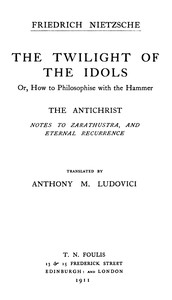
Before opening The Twilight of the Idols; or, How to Philosophize with the Hammer. The Antichrist Complete Works, Volume Sixteen — Background and Themes, the edition data offers a quick orientation: 74,942 words, 5 hr 26 min estimated reading time, and 8 detected text sections.
The text analysis averages about 23.6 words per sentence, while the detected sections provide another way to judge how the source is divided.
Project Gutenberg metadata also associates the work with “Philosophy,” connecting these edition facts with the source record’s subject description.
Explore this collection
These alternatives are selected using recorded categories and estimated reading time.
About 333 minutes
Ethics
76,469 recorded words. 7 minutes difference from this book's estimate.
View Gutenberg source #11945About 337 minutes
Ethics
77,457 recorded words. 11 minutes difference from this book's estimate.
View Gutenberg source #33677About 350 minutes
Ethics
80,452 recorded words. 24 minutes difference from this book's estimate.
View Gutenberg source #18936Search stored excerpts and compare books → Choose by your preferences →
Choices use stored catalog measurements. Estimates vary with reading speed. A shared category is a catalog label, not a claim that two books have the same argument or literary quality.
Search reads excerpt text stored with this catalog and links to its associated Gutenberg record. The connection is stored in the site database; this tool does not recheck that every excerpt is word-for-word identical to that external record. Excerpt search does not cover every chapter and does not verify historical publication dates.
Catalog snapshot checked: 2026-09-25. Coverage: 92 public books, 92 available source excerpts.
Calculated from edition completeness, EPUB availability, text structure and catalogue metadata. Not a user rating.
Total of 100 points, scaled to a 2.5-5.0 range. Editions with an empty description or a missing EPUB file are not scored.
Public-domain source text
The source text is kept in the dedicated reader, separate from this catalogue record and its commentary.
Nietzsche's The Twilight of the Idols (1888) opens with a preface that announces a revaluation of all values, using the metaphor of a hammer to sound out hollow idols. The work's aphoristic structure—ranging from maxims to sustained assaults on Socrates, morality, and Christianity—reflects a deliberate stylistic choice: each section functions as a blow. The translator Anthony M. Ludovici, in his preface, notes the book was composed in a matter of days, lending it a compressed, urgent tone. The title itself, as Nietzsche explains in Ecce Homo, signals that “the old truth is on its last legs.”
The opening section, “Maxims and Missiles,” establishes Nietzsche's preferred weapon: the aphorism. Sentences are short, often paradoxical, and designed to provoke rather than persuade. For example, he writes that “consciousness … now seems to us rather a symptom of relative imperfection in the organism.” This diction—clinical, dismissive, and metaphorical—recurs throughout. The hammer is not a tool for destruction alone; it is used to “sound out” idols, to test their hollowness. Nietzsche's voice is that of a psychologist diagnosing cultural decay, not a systematic philosopher building arguments. The aphorisms often end with a sharp turn, leaving the reader to complete the thought.
In “The Problem of Socrates,” Nietzsche diagnoses the Greek philosopher as a symptom of decline. He claims Socrates' dialectic is a form of revenge, a weapon of the weak against the noble instincts. The language is deliberately provocative: Socrates is called a “buffoon” and his method a “tyranny.” Nietzsche's critique hinges on the idea that reason, when elevated above instinct, signals decadence. He writes that “the most important thing about him, the ‘pure spirit,’ would remain over”—a sarcastic dismissal of the Socratic legacy. This section exemplifies Nietzsche's method of attacking revered figures by inverting their value, using vivid, almost theatrical imagery.
“The Four Great Errors” targets causality, free will, and moral responsibility. Nietzsche argues that the concept of free will is a theological fiction invented to justify punishment. He writes that “we deny that anything can be done perfectly so long as it is done consciously,” linking consciousness itself to imperfection. The style here is more expository but retains the combative edge: each error is dissected with a mixture of psychological insight and rhetorical force. Nietzsche's critique of causality—that we mistake sequence for consequence—foreshadows later philosophical developments. The section ends by tying these errors to Christian morality, setting up the later attack on religion.
In the excerpt from “The Antichrist,” Nietzsche systematically lists the imaginary elements of Christianity: causes, effects, beings, natural history, psychology, and teleology. He calls it a “purely fictitious world” that “falsifies, depreciates and denies” reality. The diction is repetitive and incantatory, each clause beginning with “nothing but” or “imaginary.” He traces the origin of this fiction to “hatred of nature” and “the man who suffers from reality.” The passage culminates in a definition of decadence as “the preponderance of pain over pleasure.” Nietzsche's voice here is that of a diagnostician, using clinical language to pathologize religious belief.
This edition, translated by Anthony M. Ludovici and edited by Oscar Levy, presents Nietzsche's late style at its most concentrated. Readers should attend to the rhythm of the aphorisms and the deliberate provocations. The work is best approached not as a systematic treatise but as a series of targeted strikes, each requiring the reader to pause and consider the assumptions under attack. The hammer, after all, is meant to be heard.
There’s a strange comfort in holding Nietzsche’s hammer while remembering gentler arguments. Reading his late, bitter aphorisms, I kept thinking of an old, patient book I once leafed through—Philosophical Works, v. 2, where revisions felt like quiet conversations. That edition seemed to soften what the hammer strikes. Odd, how a polemic can remind you of a whisper. Philosophical Works, v. 2 (of 4) Including All the Essays, and Exhibiting the More Important Alterations and Corrections in the Successive Editions Published by the — Key Ideas to Explore
Use these questions to collect your thoughts before moving on.