About 60 minutes
A philosophicall essay for the reunion of the languages — Background and Themes
Ethics
13,624 recorded words. 2 minutes difference from this book's estimate.
View Gutenberg source #15649
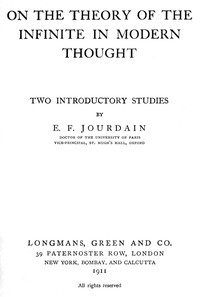
This digital edition of On the theory of the infinite in modern thought — Context and Discussion is described by source-level measurements including 13,176 words, 58 min estimated reading time, and 6 detected text sections.
The text analysis averages about 24.2 words per sentence, while the detected sections provide another way to judge how the source is divided.
Project Gutenberg metadata also associates the work with “Knowledge, Theory of,” connecting these edition facts with the source record’s subject description.
Explore this collection
These alternatives are selected using recorded categories and estimated reading time.
About 60 minutes
Ethics
13,624 recorded words. 2 minutes difference from this book's estimate.
View Gutenberg source #15649About 60 minutes
Ethics
13,780 recorded words. 2 minutes difference from this book's estimate.
View Gutenberg source #29641About 56 minutes
Ethics
12,691 recorded words. 2 minutes difference from this book's estimate.
View Gutenberg source #76629Search stored excerpts and compare books → Choose by your preferences →
Choices use stored catalog measurements. Estimates vary with reading speed. A shared category is a catalog label, not a claim that two books have the same argument or literary quality.
Search reads excerpt text stored with this catalog and links to its associated Gutenberg record. The connection is stored in the site database; this tool does not recheck that every excerpt is word-for-word identical to that external record. Excerpt search does not cover every chapter and does not verify historical publication dates.
Catalog snapshot checked: 2026-09-25. Coverage: 92 public books, 92 available source excerpts.
Calculated from edition completeness, EPUB availability, text structure and catalogue metadata. Not a user rating.
Total of 100 points, scaled to a 2.5-5.0 range. Editions with an empty description or a missing EPUB file are not scored.
Public-domain source text
The source text is kept in the dedicated reader, separate from this catalogue record and its commentary.
The two lectures that make up this volume were delivered five years apart—the first to women science students at Oxford in 1905, the second to the Philosophical Society of St. Hugh’s Hall in 1908. Their author, Eleanor F. Jourdain, was Vice-Principal of St. Hugh’s and held a doctorate from the University of Paris. The lectures are printed here with minimal revision, retaining the direct address of the spoken form. Jourdain’s central claim is that the redefinition of mathematics as a science of relations, independent of space and time intuitions, allows a new alliance with philosophy. She traces this shift through the work of thinkers such as Cantor, Bradley, and James, and uses it to argue against pragmatist denials of an Absolute.
Jourdain opens by asserting that mathematics, as now understood, is “based, like formal logic, on the prerequisites of thought, not on the notions of space and time.” This marks a departure from the Kantian view that mathematics rests on intuitions of space and time. She argues that the new mathematics is a “science of relations rather than of mere number,” and that it can exist “out of conditions of time and space as we know them.” This redefinition allows mathematics to serve as a “valuable aid and illustration to philosophy,” while philosophy can in turn “imagine lines for the exercise of the constructive power involved in mathematics.” The lecture thus sets up a reciprocal relationship between the two disciplines, grounded in the logical structure of thought itself.
Jourdain engages critically with pragmatist thinkers, particularly William James, whom she quotes as saying, “I personally give up the Absolute. I find it entangles me in metaphysical paradoxes that are inacceptable.” She also examines the arguments of Bax, who posits a “moving synthesis” as the goal of thought, and contends that such a view inadvertently proves the existence of an Absolute: “the appearance of the goal of thought as a moving synthesis would presuppose an Absolute as a ground reality.” Jourdain’s rebuttal relies on the mathematician’s concept of the series of all finite and transfinite ordinal numbers, which she sees as leading to the proof of an “Absolute Infinite.” The structure of her argument moves from specific philosophical positions to a broader mathematical foundation.
In the second lecture, Jourdain turns to the pragmatist appeal to facts over scientific law and logic. She notes the inconsistency: “If he consistently denied logic, his position would be unassailable by logic, but he uses the method he denies, and is thus open to attack.” She acknowledges the pragmatist point that there is “no actual continuity between a fact and a law,” but counters that laws are concepts—the result of mental activities—and that the denial of logic itself requires logical reasoning. This section is notable for its tight, almost syllogistic structure, as Jourdain systematically exposes the self-referential problems in the pragmatist position. The lecture form allows her to build her case step by step, addressing objections as they arise.
Throughout both lectures, Jourdain returns to the image of a background or ground against which change is perceived. She cites Bax’s argument that everything we perceive is seen “against a background which itself moves,” and that this implies no fixed Absolute. Jourdain inverts this: only the permanent can produce the phenomena of change. She also references Ormond’s “Foundations of Knowledge” and Illingworth’s “Doctrine of the Trinity” to support the idea that “the evolutionary aspect of the world itself” must be connected to “a ground reality that is stable.” This recurring visual metaphor—of shifting figures against a stable ground—gives the abstract argument a concrete, almost spatial dimension, and ties together the mathematical and philosophical threads of the work.
Jourdain’s lectures are best approached as a pair of linked arguments rather than a comprehensive treatise. The first lecture establishes the mathematical foundation; the second applies it to contemporary philosophical debates. Readers unfamiliar with the work of Cantor or the pragmatist school may find it helpful to consult a primer on transfinite numbers or William James’s pragmatism. Jourdain’s prose is clear and direct, but the arguments are dense and repay careful reading. The lectures offer a window into early twentieth-century attempts to reconcile new mathematical discoveries with enduring metaphysical questions.
There’s something strangely comforting in how those 1905 lectures treated the infinite not as a mystery to fear, but as a quiet structure we could think with. It reminds me of an old volume on commerce I once found, Morals in Trade and Commerce — Themes and Context, where fairness felt similarly abstract, yet reachable. Both left me with a gentler sense of order in things.
Use these questions to collect your thoughts before moving on.