About 154 minutes
Revolted Woman: Past, present, and to come — Background and Themes
Ethics
35,229 recorded words. 3 minutes difference from this book's estimate.
View Gutenberg source #58496
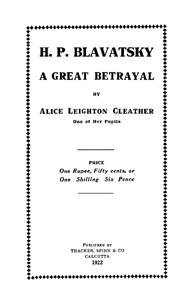
The catalog record for H. P. Blavatsky; A Great Betrayal — A Reader’s Guide provides practical reading context through 34,536 words, 2 hr 31 min estimated reading time, and 4 detected text sections.
The text analysis averages about 17.3 words per sentence, while the detected sections provide another way to judge how the source is divided.
Project Gutenberg metadata also associates the work with “Blavatsky, H. P. (Helena Petrovna), 1831-1891,” connecting these edition facts with the source record’s subject description.
Explore this collection
These alternatives are selected using recorded categories and estimated reading time.
About 154 minutes
Ethics
35,229 recorded words. 3 minutes difference from this book's estimate.
View Gutenberg source #58496About 157 minutes
Ethics
36,110 recorded words. 6 minutes difference from this book's estimate.
View Gutenberg source #58058About 163 minutes
Ethics
37,420 recorded words. 12 minutes difference from this book's estimate.
View Gutenberg source #14209Search stored excerpts and compare books → Choose by your preferences →
Choices use stored catalog measurements. Estimates vary with reading speed. A shared category is a catalog label, not a claim that two books have the same argument or literary quality.
Search reads excerpt text stored with this catalog and links to its associated Gutenberg record. The connection is stored in the site database; this tool does not recheck that every excerpt is word-for-word identical to that external record. Excerpt search does not cover every chapter and does not verify historical publication dates.
Catalog snapshot checked: 2026-09-25. Coverage: 92 public books, 92 available source excerpts.
Calculated from edition completeness, EPUB availability, text structure and catalogue metadata. Not a user rating.
Total of 100 points, scaled to a 2.5-5.0 range. Editions with an empty description or a missing EPUB file are not scored.
Public-domain source text
The source text is kept in the dedicated reader, separate from this catalogue record and its commentary.
Alice Leighton Cleather, a former pupil of H.P. Blavatsky, structures her polemic around a central accusation: that Annie Besant and C.W. Leadbeater betrayed Blavatsky's esoteric legacy. The book's diction is consistently adversarial, employing legal and moral terminology such as 'indictment,' 'responsibility,' and 'corruption.' Cleather juxtaposes quoted material—including a letter from Blavatsky's Master and a passage from the Buddha's Anguttura Nikaya—against what she presents as Besant and Leadbeater's distortions. This editorial note examines three authorial choices: the use of embedded documents to claim authority, the rhetorical framing of Leadbeater's call for implicit obedience, and the strategic deployment of italics and exclamation to signal outrage.
Cleather repeatedly inserts letters, quotations, and excerpts from other works into her narrative, treating them as documentary proof. The epigraph from Blavatsky's Master—'Behold the truth before you! a clean life, an open mind'—establishes a moral standard against which Besant and Leadbeater are measured. Later, she reproduces a lengthy passage from Leadbeater's speech that demands followers obey Besant 'implicitly, just because she knows.' By placing these texts side by side, Cleather creates a courtroom-like structure where the reader is asked to judge discrepancies. The effect is to shift authority from the author's own voice to the quoted sources, implying that the evidence speaks for itself. However, the excerpts are incomplete; Cleather selects only those portions that support her case, leaving the full context of Leadbeater's remarks unexamined.
Cleather's most pointed critique targets Leadbeater's demand for 'deliberate suppression of thought.' She characterizes this as a call to 'mental torpor' and contrasts it with the Buddha's injunction: 'Believe not solely upon the authority of your Masters and elders.' The diction here is deliberately inflammatory—'impious prophet,' 'obedient automata'—and Cleather uses italics to emphasize key phrases. She also employs a dramatic, almost visionary passage: 'A gentle and winning voice, infinitely reassuring, rises out of the depths of my being ... a great light breaks forth.' This shift from analytical prose to quasi-mystical experience is a notable stylistic choice, intended to position Cleather as a defender of rational inquiry against blind faith. Yet the passage is ambiguous: it could be read as sincere spiritual conviction or as a rhetorical device to claim higher authority.
Throughout the book, Cleather selects words that evoke moral decay: 'corruption,' 'betrayal,' 'superstition in its grossest form,' 'sectarian tactics.' The title itself—A Great Betrayal—frames the entire work as a revelation of treachery. In the chapter 'Tampering with H. P. Blavatsky's Writings,' she accuses Besant of altering Blavatsky's texts, using the verb 'tampering' to suggest malicious interference. The phrase 'Annie Besant's Corruption of the Secret Doctrine' (a chapter heading) reinforces this theme. Cleather's descriptive choices are not neutral; they guide the reader toward a predetermined judgment. For instance, she describes Leadbeater's followers as lacking 'a highly developed critical faculty,' a characterization that dismisses their agency. This adversarial diction is consistent with the book's purpose as a polemic, but it also limits nuance, presenting a binary of pure origins versus corrupt successors.
Cleather organizes her argument by alternating between her own commentary and extended quotations, creating a rhythm of accusation and evidence. The chapter 'H. P. Blavatsky on True Occultism' precedes 'Mrs. Besant's Responsibility and The Madras Law-suits,' implying that Blavatsky's teachings provide the standard against which Besant's actions are judged. Within the excerpts, Cleather inserts bracketed italics—'[Italics mine.—A.L.C.]'—to draw attention to specific words, a technique that foregrounds her interpretive lens. She also uses the Buddha's words as a concluding counterpoint to Leadbeater's speech, a structural choice that positions ancient wisdom against modern error. However, the excerpts are too brief to assess how consistently Cleather maintains this contrast across the full text. The available passages suggest a tightly controlled narrative, but the complete book may contain more varied rhetorical strategies.
Cleather's editorial choices—embedding documents, employing charged diction, and structuring contrasts—reveal a writer deeply invested in defending a particular interpretation of Blavatsky's legacy. Readers should approach the book as a partisan account, noting how the author's selection and framing of evidence shape the narrative. The excerpts do not allow verification of all claims, but they offer a clear view of Cleather's rhetorical methods. For those studying Theosophical history, this work provides insight into the factional disputes that followed Blavatsky's death, as well as the literary strategies used to contest authority within esoteric movements.
I kept thinking about how Blavatsky’s own followers turned her words into weapons, and that ache of watching a legacy get reshaped by others. The way Revolted Woman: Past, present, and to come — Background and Themes traces that same quiet distortion—how ideals harden into something colder—stayed with me long after I closed it. Some books just sit beside you like that.
Save your reaction, strongest insight, and memorable passage.