About 75 minutes
The Game of Logic — Text and Context
Logic
17,053 recorded words. 18 minutes difference from this book's estimate.
View Gutenberg source #4763
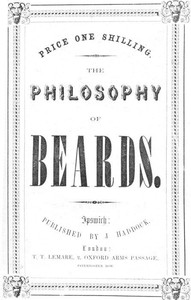
This digital edition of The Philosophy of Beards A Lecture Physiological, Artistic & Historical — Reading Companion is described by source-level measurements including 21,196 words, 1 hr 33 min estimated reading time, and 8 detected text sections.
The text analysis averages about 28.2 words per sentence, while the detected sections provide another way to judge how the source is divided.
Project Gutenberg metadata also associates the work with “Beards,” connecting these edition facts with the source record’s subject description.
Explore this collection
These alternatives are selected using recorded categories and estimated reading time.
About 75 minutes
Logic
17,053 recorded words. 18 minutes difference from this book's estimate.
View Gutenberg source #4763About 142 minutes
Logic
32,495 recorded words. 49 minutes difference from this book's estimate.
View Gutenberg source #5608About 161 minutes
Logic
36,817 recorded words. 68 minutes difference from this book's estimate.
View Gutenberg source #4544Search stored excerpts and compare books → Choose by your preferences →
Choices use stored catalog measurements. Estimates vary with reading speed. A shared category is a catalog label, not a claim that two books have the same argument or literary quality.
Search reads excerpt text stored with this catalog and links to its associated Gutenberg record. The connection is stored in the site database; this tool does not recheck that every excerpt is word-for-word identical to that external record. Excerpt search does not cover every chapter and does not verify historical publication dates.
Catalog snapshot checked: 2026-09-25. Coverage: 92 public books, 92 available source excerpts.
Calculated from edition completeness, EPUB availability, text structure and catalogue metadata. Not a user rating.
Total of 100 points, scaled to a 2.5-5.0 range. Editions with an empty description or a missing EPUB file are not scored.
Public-domain source text
The source text is kept in the dedicated reader, separate from this catalogue record and its commentary.
Thomas S. Gowing opens his lecture by invoking Hamlet's praise of man as 'the beauty of the world! the paragon of animals!' only to lament that this same creature 'can despise his reason! ignore his infinite faculties! deliberately deface that form so express and admirable!' by shaving. This rhetorical pivot—from Shakespearean elevation to satirical dismay—establishes Gowing's method: he uses literary and historical evidence to argue that beards are natural, artistic, and patriotic. The lecture, originally delivered to a 'numerous and good-humoured auditory' in Ipswich, was expanded with notes for publication. Gowing's preface thanks his publisher and notes that illustrations, including a drawing of 'the ape and the goat,' were adapted for the printed edition.
Gowing's prose relies on sharp juxtapositions. He sets Hamlet's noble vision against the 'parody of animals' produced by shaving, and personifies Fashion as a 'most capricious goddess' who can transform the lovely into the disgusting. This binary structure—reason versus folly, nature versus artifice—recurs throughout. In the historical section, he contrasts the bearded majority with smooth-faced courtiers, as when he notes that Edward IV 'shaved out of foppery' while Richard III, 'that smooth-faced rascal,' could 'smile and smile and be a villain.' The allusion to Shakespeare's Hamlet and Richard III is not merely decorative; it anchors Gowing's moral argument in familiar cultural touchstones. He also uses Chaucer's descriptions of pilgrims' beards—the merchant's 'forked Beard,' the miller's 'red as a fox'—to show that facial hair once signified character and station. By contrasting these vivid portraits with the 'Pardonere' who 'had no Beard,' Gowing implies that shaving erases individuality.
Gowing's historical argument proceeds through a series of pointed anecdotes rather than systematic analysis. He recounts how Sir Thomas More, before his execution, placed his beard aside on the block, remarking 'that it at least was guiltless of treason.' The story serves both as a moral lesson and as a wry commentary on political hypocrisy. Another anecdote describes the chancellor Duprat taxing clergy beards, leading to a revenge plot in which a bishop-elect was barred from his see unless he sacrificed his 'handsomest' beard—a humiliation said to have caused his death. Gowing also reports that Emperor Charles V's painter, John Mayo, had a beard so long he could stand on it, and that the emperor would unfasten it at table to watch it blow into courtiers' faces. These tales, drawn from sources Gowing does not always name, are chosen for their dramatic and comic value, reinforcing his claim that beards have been central to identity, power, and ridicule.
Though the excerpts do not include the full physiological argument, Gowing's title promises a 'Physiological' dimension, and his preface indicates that notes were added after delivery. The lecture likely draws on contemporary medical ideas about hair growth and health, common in Victorian hygiene debates. Gowing's approach is not clinical but persuasive: he treats the beard as a natural outgrowth that shaving opposes. His reference to 'the Ape and the Goat' in the preface and title page suggests he used animal comparisons to mock the shaven face as unnatural. The physiological section probably argued that shaving weakens the body or exposes the skin to harm, though the surviving text emphasizes historical and artistic evidence. Readers should note that Gowing's 'philosophy' is less a systematic treatise than a polemic marshaling whatever evidence supports his case.
Gowing closes his preface with a salute: 'Vivat Regina! Floreat Barba!'—'Long live the Queen! May the Beard flourish!' This pairing of monarchy and facial hair is no accident. Throughout the lecture, English kings are judged by their beards: Henry VIII 'had his Beard close clipped,' while Edward VI 'died before his Beard developed.' Gowing implies that a bearded nation is a virtuous one, and that shaving follows foreign or decadent fashions. He praises the common people who 'stuck to their Beards, uninfluenced by the fluctuations of court fashions,' aligning the beard with sturdy English independence. The lecture thus becomes a patriotic appeal as much as a physiological or aesthetic one. Gowing's tone is consistently good-humored, but his underlying argument is serious: the beard is a marker of natural order, national character, and moral integrity.
Gowing's lecture is best approached as a period piece of Victorian polemic—learned, witty, and unapologetically biased. Readers interested in the history of grooming, nineteenth-century popular science, or the rhetoric of reform will find it a rich specimen. The author's voice is confident and conversational, peppered with literary allusions and comic asides. Those seeking a balanced medical or historical survey should look elsewhere; Gowing's aim is persuasion, not impartiality. The lecture rewards attention to its rhetorical strategies and the cultural assumptions it reveals.
Some evenings, one finds a peculiar comfort in old defenses—a beard’s quiet rebellion, or a soul’s solitary examination. Gowing’s whiskered earnestness and the mystical treatises share a whispered kinship: both are stubborn, kindly witnesses to a gentler interior struggle. Decades shelved together, they breathe the same patient air, like The Cell of Self-Knowledge : seven early English mystical treatises printed by Henry Pepwell in 1521 — A Reader’s Guide, asking only for unhurried attention.
Capture what you thought, learned, and would like to remember.