About 161 minutes
The Cell of Self-Knowledge : seven early English mystical treatises printed by Henry Pepwell in 1521 — A Reader’s Guide
Logic
36,817 recorded words. 0 minutes difference from this book's estimate.
View Gutenberg source #4544
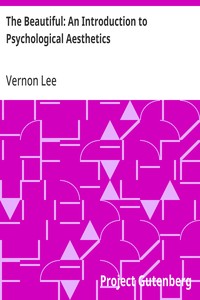
This digital edition of The Beautiful: An Introduction to Psychological Aesthetics — Reading Notes is described by source-level measurements including 36,929 words, 2 hr 41 min estimated reading time, and 5 detected text sections.
The text analysis averages about 36.3 words per sentence, while the detected sections provide another way to judge how the source is divided.
Project Gutenberg metadata also associates the work with “Psychology, Applied,” connecting these edition facts with the source record’s subject description.
Explore this collection
These alternatives are selected using recorded categories and estimated reading time.
About 161 minutes
Logic
36,817 recorded words. 0 minutes difference from this book's estimate.
View Gutenberg source #4544About 167 minutes
Logic
38,203 recorded words. 6 minutes difference from this book's estimate.
View Gutenberg source #38114About 142 minutes
Logic
32,495 recorded words. 19 minutes difference from this book's estimate.
View Gutenberg source #5608Search stored excerpts and compare books → Choose by your preferences →
Choices use stored catalog measurements. Estimates vary with reading speed. A shared category is a catalog label, not a claim that two books have the same argument or literary quality.
Search reads excerpt text stored with this catalog and links to its associated Gutenberg record. The connection is stored in the site database; this tool does not recheck that every excerpt is word-for-word identical to that external record. Excerpt search does not cover every chapter and does not verify historical publication dates.
Catalog snapshot checked: 2026-09-25. Coverage: 92 public books, 92 available source excerpts.
Calculated from edition completeness, EPUB availability, text structure and catalogue metadata. Not a user rating.
Total of 100 points, scaled to a 2.5-5.0 range. Editions with an empty description or a missing EPUB file are not scored.
Public-domain source text
The source text is kept in the dedicated reader, separate from this catalogue record and its commentary.
Vernon Lee opens The Beautiful by addressing readers with no prior knowledge of psychology, grounding her explanation in familiar mental facts rather than elementary processes. The book's central concern is aesthetic preference for visible shapes, and Lee repeatedly distinguishes between shapes as two-dimensional and things as three-dimensional, arguing that qualities like weight and texture belong to things, not shapes. This distinction underpins her discussion of empathy (Einfühlung), where effort and resistance are extracted from bodily experience and attributed to shapes. The excerpts show a methodical, example-driven approach, using everyday observations—such as a floor pattern appearing convex or concave depending on how we interpret it—to illustrate psychological principles.
Lee insists that visible shapes, though often aspects of cubic objects, have no body: they are two-dimensional and bodiless. The perception of three-dimensional space, she argues, is not directly given by vision but inferred from locomotor experience—muscular adjustments that become associated with two-dimensional arrangements of colour and light. She offers a striking test: making one colour of a floor pattern seem convex or concave by thinking of it as a light flower on a dark ground or a white cavity banked by a dark ridge. This shows that we do not really see three-dimensional objects but infer them by connecting visual data with locomotor results. The philistine who objects to unfamiliar painting styles, Lee notes, is often merely unable to identify two-dimensional shapes as representing three-dimensional things.
Lee defines empathy (Einfühlung) as the extraction and schematisation of effort and resistance, achieved by eliminating the thought of weight and awareness of bodily tensions. This elimination allows us to attribute activities to two-dimensional shapes and feel those activities vividly. She anticipates the objection that effort and resistance must involve weight, which shapes cannot possess. Her answer is that empathy has schematised these qualities by removing incompatible elements. The process is thus a refinement, not a contradiction, of the shape-thing distinction. Lee's approach is consistently psychological: she treats empathy as a mental operation that transforms bodily experience into aesthetic response, without invoking metaphysical claims about beauty.
Lee explicitly addresses two audiences: the lay reader, for whom she explains aesthetic problems using familiar mental facts, and the psychologist, to whom she offers the volume as a possible addition to facts and hypotheses. She acknowledges that her terms correspond only approximately to psychological fact, and she avoids misleading readers about complexes like memory and association. The book's structure—twenty-one chapters moving from the adjective 'beautiful' through contemplative satisfaction, aspects versus things, sensations, perception of relations, elements of shape, and empathy to aesthetic responsiveness and irradiation—reflects a systematic but accessible progression. Lee's tone is apologetic and careful, aware of the gap between everyday vocabulary and scientific precision.
Readers should note that Lee's argument is built on a series of precise distinctions—between shape and thing, sensation and perception, subject and object—that she develops incrementally. The excerpts reveal a writer who tests her claims with concrete examples and anticipates objections. The book rewards attention to these distinctions and to the way Lee uses everyday experience to ground psychological theory. For those interested in the history of aesthetics, The Beautiful offers a clear, non-technical entry into early twentieth-century psychological approaches to art.
Reading Lee’s careful separation of two-dimensional shapes from tactile things, I recalled standing before a fresco as a child, tracing its flatness with my eyes while my fingers itched for relief. Another day, I found that same strange hunger in The Ethics of the Dust — A Reader’s Guide — how Ruskin made stones feel like waiting bodies.
Your answers remain private and are stored only in this browser.