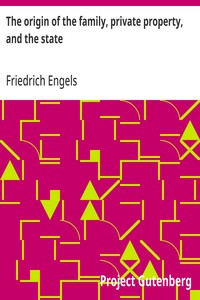
The origin of the family, private property, and the state — Themes and Context

(0 User reviews)   379
In Category - Ethics
Engels, Friedrich, 1820-1895, Untermann, Gerhard Ernest, 1864-1956 [Translator] Project Gutenberg 2010 Not confirmed
Prehistoric peoples; State, The; Families -- History; Property -- History; Morgan, Lewis Henry, 1818-1881. Ancient society Readers of public-domain and historical texts
Project Gutenberg digital edition en

Edition facts

Words 67,944
Reading time 296 min
Text sections 8

The source record for The origin of the family, private property, and the state — Themes and Context measures this digital text at 67,944 words, 4 hr 56 min estimated reading time, and 8 detected text sections.

The text analysis averages about 22.1 words per sentence, while the detected sections provide another way to judge how the source is divided.

Project Gutenberg metadata also associates the work with “Prehistoric peoples,” connecting these edition facts with the source record’s subject description.

Engels traces the evolution of family structures, property relations, and the state from prehistoric times through ancient Greece, Rome, and Germanic tribes, drawing on Morgan's research and emphasizing the role of class struggle.
Share
Editorial Edition Score 4.7/5

Calculated from edition completeness, EPUB availability, text structure and catalogue metadata. Not a user rating.

How this score is calculated
  • Description quality20 pts
  • Title & short description10 pts
  • Source metadata20 pts
  • Text length15 pts
  • Chapters / structure15 pts
  • EPUB file integrity20 pts

Total of 100 points, scaled to a 2.5-5.0 range. Editions with an empty description or a missing EPUB file are not scored.

Edition quality

Read the Text

Morgan was the first to make an attempt at introducing a logical order into the history of primeval society. Until considerably more material is obtained, no further changes will be necessary and his arrangement will surely remain in force.

Of the three main epochs--savagery, barbarism and civilization--naturally only the first two and the transition to the third required his attention. He subdivided each of these into a lower, middle and higher stage, according to the progress in the production of the means of sustenance. His reason for doing so is that the degree of human supremacy over nature is conditioned on the ability to produce the necessities of life. For of all living beings, man alone has acquired an almost unlimited control over food production. All great epochs of human progress, according to Morgan, coincide more or less directly with times of greater abundance in the means that sustain life. The evolution of the family proceeds in the same measure without, however, offering equally convenient marks for sub-division.

1. Lower Stage. Infancy of the human race. Human beings still dwelt in their original habitation, in tropical or subtropical forests. They lived at least part of the time in trees, for only in this way they could escape the attacks of large beasts of prey and survive. Fruit, nuts, and roots served as food. The formation of articulated speech is the principal result of this period. Not a single one of all the nations that have become known in historic times dates back to this primeval stage.

Although the latter may extend over thousands of years, we have no means of proving its existence by direct evidence. But once the descent of man from the Animal Kingdom is acknowledged, the acceptance of this stage of transition becomes inevitable.

2. Middle Stage: Commencing with the utilization of fish (including crabs, mollusks and other aquatic animals) and the use of fire. Both these things belong together, because fish becomes thoroughly palatable by the help of fire only. With this new kind of food, human beings became completely independent of climate and locality. Following the course of rivers and coastlines, they could spread over the greater part of the earth even in the savage state. The so-called palaeolithic implements of the early stone age, made of rough, unsharpened stones, belong almost entirely to this period. Their wide distribution over all the continents testifies to the extent of these wanderings. The unceasing bent for discovery, together with the possession of fire gained by friction, created new products in the lately occupied regions. Such were farinaceous roots and tubers, baked in hot ashes or in baking pits (ground ovens). When the first weapons, club and spear, were invented, venison was occasionally added to the bill of fare. Nations subsisting exclusively by hunting, such as we sometimes find mentioned in books, have never existed; for the proceeds of hunting are too uncertain. In consequence of continued precariousness of the sources of sustenance, cannibalism seems to arise at this stage. It continues in force for a long while. Even in our day, Australians and Polynesians still remain in this middle stage of savagery.

3. Higher Stage: Coming with the invention of bow and arrow, this stage makes venison a regular part of daily fare and hunting a normal occupation. Bow, arrow and cord represent a rather complicated instrument, the invention of which presupposes a long and accumulated experience and increased mental ability; incidentally they are conditioned on the acquaintance with a number of other inventions.

In comparing the nations that are familiar with the use of bow and arrow, but not yet with the art of pottery (from which Morgan dates the transition to barbarism), we find among them the beginnings of village settlements, a control of food production, wooden vessels and utensils, weaving of bast fibre by hand (without a loom), baskets made of bast or reeds, and sharpened (neolithic) stone implements. Generally fire and the stone ax have also furnished the dugout and, here and there, timbers and boards for house-building. All these improvements are found, e. g., among the American Indians of the Northwest, who use bow and arrows, but know nothing as yet about pottery. Bow and arrows were for the stage of savagery what the iron sword was for barbarism and the fire-arm for civilization; the weapon of supremacy.

1. Lower Stage. Dates from the introduction of the art of pottery. The latter is traceable in many cases, and probably attributable in all cases, to the custom of covering wooden or plaited vessels with clay in order to render them fire-proof. It did not take long to find out that moulded clay served the same purpose without a lining of other material.

Engels opens with a detailed examination of the Iroquois confederacy, presenting its council of fifty sachems, unanimous voting, and public assemblies as a model of stateless governance. He highlights how the gens—a kinship group—serves as the social unit, with phratries and tribes forming naturally from it. This concrete example grounds his broader argument that the state emerges only when a public coercive power separates from the body of members.

The Iroquois Gens as a Structural Template

Engels devotes an entire chapter to the Iroquois gens, using it to illustrate a society without a state. He enumerates ten features of the Iroquois league, including the equality of sachems, the requirement of unanimity, and the absence of an executive chief. The description is methodical: each rule is stated plainly, then linked to the broader principle that the state presupposes a separated public power. Engels notes that the same gentile constitution appears across widely separated tribes, with wolf and bear names persisting as evidence of common origin. This structural analysis serves as a benchmark against which later state formations are measured.

Movement from Kinship to Territory

The transition from gentile to political organization is traced through three ancient societies: Athens, Rome, and among the Germans. In each case, Engels shows how territorial divisions replace kinship bonds. The Attic state, for instance, emerges from a series of reforms that break up the old gentes and introduce a new administrative system based on demes. The Roman gens similarly gives way to a state organized by classes and centuries. The German case is presented as a later, more gradual shift, where the mark constitution—a purely social institution—provides the foundation on which a state is later erected. Engels emphasizes that these movements are not accidental but follow from changes in production and property.

Recurring Images of the Gens as Organism

Throughout the text, Engels returns to the image of the gens as a living, self-sufficient organism. He describes how the gens, phratry, and tribe form a cycle of functions that covers all public affairs in the lower stage of barbarism. The language is biological: gentes "split up," "mother gentes" are preserved in phratries, and the whole constitution develops with "almost unavoidable necessity." This organic metaphor reinforces the idea that gentile society is natural and self-regulating, in contrast to the artificial, coercive state. The same imagery reappears in discussions of the German mark, which Engels calls a "purely social institution" that could later support a state constitution.

The Translator’s Frame and the Class Struggle

Ernest Untermann’s preface frames the work explicitly as socialist propaganda. He argues that the message of Bachofen, Morgan, Marx, and Darwin has been suppressed because it is "dangerous to the existing order." Untermann claims that Morgan, despite his radicalism, was prevented by his environment from pointing out the class struggle—a gap Engels fills. This editorial framing colors the entire text, positioning it as a weapon against the idea that society is divinely ordained. The translator’s voice is urgent: he names the ruling class, exploitation, and the need for a socialist summary. Readers should note that this preface, while not by Engels, sets the political stakes for the analysis that follows.

Engels builds his argument through careful comparison of kinship-based and state-based societies, using the Iroquois confederacy as a recurring touchstone. Readers will benefit from tracking how each chapter returns to the same structural features—the gens, the council, the absence of coercion—and modifies them as property relations shift. The excerpts provide a clear view of his method, though the full work extends these patterns across more societies and into the rise of the modern state.

Reading Engels on how kinship shapes power, I remembered sitting on a porch swing as a teen, turning pages of What All The World's A-Seeking The Vital Law of True Life, True Greatness Power and Happiness — Edition Insights. Both felt like finding a quiet door in a familiar wall. There was a certain ache—not sadness, but recognition—seeing how unseen structures cradle our choices, long before we name them.

There are no reviews for this eBook.

0
0 out of 5 (0 User reviews )

Add a Review

Your Rating *
There are no comments for this eBook.

Reader reflection

Your personal reading reflection

Build a private reading journal entry for this title.

Your progress 0 / 10
1

What is your current status with this title?

2

How did the book work for you overall?

3

Would you encourage someone else to read it?

4

How demanding did the text feel?

Related eBooks