About 1,173 minutes
A Christian Directory, Part 4: Christian Politics — Themes and Context
Ethics
269,776 recorded words. 101 minutes difference from this book's estimate.
View Gutenberg source #43967
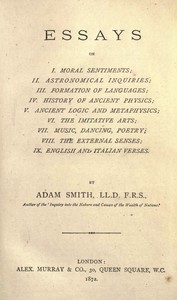
The source record for The Essays of Adam Smith — Reading Companion measures this digital text at 246,535 words, 17 hr 52 min estimated reading time, and 21 detected text sections.
The text analysis averages about 34.1 words per sentence, while the detected sections provide another way to judge how the source is divided.
Project Gutenberg metadata also associates the work with “Ethics,” connecting these edition facts with the source record’s subject description.
Explore this collection
These alternatives are selected using recorded categories and estimated reading time.
About 1,173 minutes
Ethics
269,776 recorded words. 101 minutes difference from this book's estimate.
View Gutenberg source #43967About 949 minutes
Ethics
218,147 recorded words. 123 minutes difference from this book's estimate.
View Gutenberg source #29247About 850 minutes
Ethics
195,470 recorded words. 222 minutes difference from this book's estimate.
View Gutenberg source #29412Search stored excerpts and compare books → Choose by your preferences →
Choices use stored catalog measurements. Estimates vary with reading speed. A shared category is a catalog label, not a claim that two books have the same argument or literary quality.
Search reads excerpt text stored with this catalog and links to its associated Gutenberg record. The connection is stored in the site database; this tool does not recheck that every excerpt is word-for-word identical to that external record. Excerpt search does not cover every chapter and does not verify historical publication dates.
Catalog snapshot checked: 2026-09-25. Coverage: 92 public books, 92 available source excerpts.
Calculated from edition completeness, EPUB availability, text structure and catalogue metadata. Not a user rating.
Total of 100 points, scaled to a 2.5-5.0 range. Editions with an empty description or a missing EPUB file are not scored.
Public-domain source text
The source text is kept in the dedicated reader, separate from this catalogue record and its commentary.
The Essays of Adam Smith opens with a biographical notice that traces the author's early life—his birth at Kirkaldy in 1723, a sickly childhood, and a famous episode of being carried off by tinkers—before moving into the philosophical essays themselves. The collection's structure is immediately striking: nine distinct essays ranging from moral sentiments to astronomy, language, and the imitative arts, each treated with Smith's characteristic method of moving from general principles to specific illustrations. The editor's note explains that the text is based on materials from the Internet Archive and Hathi Trust, with footnotes numbered and placed at paragraph ends, and Greek text marked by orange underlining.
Across the essays, Smith repeatedly employs a tripartite structure: he first states a general proposition, then examines it through historical or comparative examples, and finally refines it with distinctions. In the essay on moral sentiments, for instance, he discusses Plato's account of virtue as each faculty confining itself to its proper sphere, then immediately compares it to Aristotle's habit of mediocrity, and concludes by noting how both coincide with his own notion of propriety. This pattern recurs in the astronomical inquiries, where he moves from abstract principles of scientific explanation to specific ancient systems. The effect is a cumulative argument that builds through layered comparisons rather than linear deduction.
Smith's prose frequently shifts between abstract philosophical categories and concrete, almost anecdotal illustrations. In the discussion of virtue, he distinguishes between the quality of an action and the quality of a person, using the example of an occasional fit of generosity versus a habitual generous character. This movement from the general to the particular is not merely rhetorical; it reflects his method of grounding moral philosophy in observable human behavior. Similarly, in the essay on the imitative arts, he likely draws on specific examples from music, dancing, and poetry to illuminate broader principles of representation. The reader is thus constantly shuttled between theoretical frameworks and tangible instances.
Certain images and terms recur throughout the excerpts: propriety, habit, moderation, and middle appear repeatedly in the moral essays. Smith describes virtue as lying in a middle between opposite vices—cowardice and rashness, avarice and profusion, arrogance and pusillanimity. This spatial language of extremes and a mean is not confined to ethics; it echoes in his discussions of scientific systems, where he contrasts excess and defect in explanatory power. The term habit is particularly important: he insists that virtue consists not in occasional right actions but in a habitual disposition, a point he illustrates with the distinction between a generous act and a generous person. This emphasis on stability and repetition suggests a mind concerned with the enduring structures of character and knowledge.
Smith consistently situates his arguments within a historical framework, comparing ancient and modern thinkers. In the excerpts, he juxtaposes Plato and Aristotle on virtue, noting that Plato's account of justice as each faculty performing its proper office coincides with Smith's own view of propriety, while Aristotle's doctrine of the mean corresponds to his account of propriety and impropriety. This comparative method is not merely scholarly; it serves to demonstrate how philosophical problems recur across time and how different solutions illuminate each other. The essays on ancient physics and logic likely continue this pattern, showing how earlier systems of thought prefigure or contrast with modern ones. The reader is thus invited to see Smith's own work as part of a continuous intellectual tradition.
Readers approaching this collection should attend to the way Smith weaves together multiple disciplines under a consistent method. The essays reward careful attention to his use of examples and his habit of returning to key terms like propriety and habit. Because the excerpts are incomplete, the full arc of each essay—especially the later ones on the imitative arts and external senses—remains to be discovered. The editorial apparatus, including footnotes and cross-references, provides useful guidance for tracing Smith's sources and influences.
Reading his patient movement from astronomy to moral sentiments, I remembered sitting on my grandmother’s porch, turning pages of an old clothbound volume while bees worked the lavender—how some books feel like listening to one calm voice noticing patterns everywhere. We Moderns: Enigmas and Guesses — Reading Companion stirred that same quiet wonder, a sense of being gently shown the shape hiding inside chaos.
Capture what you thought, learned, and would like to remember.