About 500 minutes
The Theories of Darwin and Their Relation to Philosophy, Religion, and Morality — Inside the Classic
Ethics
114,788 recorded words. 26 minutes difference from this book's estimate.
View Gutenberg source #22150
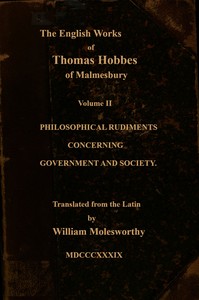
Before opening The English works of Thomas Hobbes of Malmesbury, Volume 02 (of 11) — Story, Setting & Ideas, the edition data offers a quick orientation: 108,940 words, 7 hr 54 min estimated reading time, and 18 detected text sections.
The text analysis averages about 28.3 words per sentence, while the detected sections provide another way to judge how the source is divided.
Project Gutenberg metadata also associates the work with “Philosophy, English -- 17th century,” connecting these edition facts with the source record’s subject description.
Explore this collection
These alternatives are selected using recorded categories and estimated reading time.
About 500 minutes
Ethics
114,788 recorded words. 26 minutes difference from this book's estimate.
View Gutenberg source #22150About 445 minutes
Ethics
102,313 recorded words. 29 minutes difference from this book's estimate.
View Gutenberg source #55531About 436 minutes
Ethics
100,265 recorded words. 38 minutes difference from this book's estimate.
View Gutenberg source #39955Search stored excerpts and compare books → Choose by your preferences →
Choices use stored catalog measurements. Estimates vary with reading speed. A shared category is a catalog label, not a claim that two books have the same argument or literary quality.
Search reads excerpt text stored with this catalog and links to its associated Gutenberg record. The connection is stored in the site database; this tool does not recheck that every excerpt is word-for-word identical to that external record. Excerpt search does not cover every chapter and does not verify historical publication dates.
Catalog snapshot checked: 2026-09-25. Coverage: 92 public books, 92 available source excerpts.
Calculated from edition completeness, EPUB availability, text structure and catalogue metadata. Not a user rating.
Total of 100 points, scaled to a 2.5-5.0 range. Editions with an empty description or a missing EPUB file are not scored.
Public-domain source text
The source text is kept in the dedicated reader, separate from this catalogue record and its commentary.
Thomas Hobbes's Philosophical Rudiments Concerning Government and Society opens with a striking juxtaposition: 'man to man is a kind of God' and 'man to man is an arrant wolf.' This volume, the second of an eleven-volume collected edition edited by Sir William Molesworth, presents Hobbes's political philosophy in a tightly structured sequence of chapters and numbered articles. The text moves between dense theoretical argument and pointed historical allusion, as when Hobbes invokes Cato the Censor and Pontius Telesinus to frame the tension between civil peace and predatory power. Readers will encounter a work that proceeds by definition, distinction, and refutation, building its case for absolute sovereignty through a relentless chain of reasoning.
The volume is organized into chapters, each subdivided into numbered articles—a format that gives Hobbes's argument a forensic clarity. For example, the excerpt on seditious doctrines appears under a specific article number, allowing the reader to trace how each proposition is introduced, defended, and linked to earlier conclusions. This structure mirrors Hobbes's method of building from first principles: he defines key terms (city, sovereign, law) and then derives obligations. The numbering also facilitates cross-reference; Hobbes frequently cites earlier articles, as when he refers to 'chap VI. art. 14' to support a claim about civil laws. Readers should attend to these internal links, as they form the skeleton of the entire treatise.
Hobbes's prose is punctuated by vivid, recurring images that dramatize his political theory. The wolf and the god appear in the dedicatory epistle, setting up a binary that governs the entire work: the state of nature versus civil society. Later, the image of a 'forest' that harbors wolves is invoked to argue that the very structure of popular liberty must be 'grubbed up by the roots' to secure peace. These metaphors are not ornamental; they carry argumentative weight. The wolf represents untamed human appetite, while the god signifies the justice and charity possible under a common power. Hobbes also uses the tree of knowledge from Genesis—'Who hath told thee that he was a tyrant?'—to condemn private judgment of good and evil. Tracking these images reveals how Hobbes repeatedly frames political obedience as a matter of epistemological humility.
The text shifts between different rhetorical registers: the personal address of the dedication to the Earl of Devonshire, the historical anecdote of Cato and Telesinus, and the impersonal, syllogistic style of the chapters. This movement is not arbitrary. The dedication establishes the stakes—the danger of sedition and the need for a robust theory of obligation—before the treatise proceeds to systematic exposition. Within the chapters, Hobbes alternates between stating a doctrine and refuting its opposite, as when he lists 'seditious opinions' and then dismantles them one by one. The reader moves from a broad historical panorama to tight logical distinctions, a rhythm that reinforces Hobbes's central claim: that only a clear, unyielding definition of sovereignty can prevent the slide into civil war.
This volume is part of Sir William Molesworth's collected edition of Hobbes's English works, first published in the 1830s and 1840s. The text includes footnotes collected at the end of each chapter, a feature that reflects nineteenth-century editorial practice. Molesworth's edition aimed to present Hobbes's writings in a uniform, accessible format, and the volume's typography—with its clear chapter headings and marginal notes—shapes the reading experience. Readers should be aware that the text has been modernized in spelling and punctuation from the original seventeenth-century editions. The Project Gutenberg transcription also notes minor printer's errors, corrected silently or with hyperlinks. These editorial interventions, while unobtrusive, remind us that the work we read is a historical reconstruction.
Approach this volume as a philosophical argument that demands close attention to its structure. The numbered articles reward sequential reading, but the work can also be consulted topically via its chapter headings. Hobbes's references to classical authors and biblical passages are integral to his case, not mere ornament. Readers interested in the development of social contract theory will find here one of its most uncompromising statements, articulated with a clarity that has provoked debate for centuries.
I often wonder, after all these years shelving and reshelving, how Hobbes’s Philosophical Rudiments found its quiet kin. His stern geometry of sovereignty, that bare scaffold of obligation, answers a loneliness in The Purpose of History — Inside the Classic — both know order only holds if someone remembers why it was built. Side by side, they murmur. I leave them that way.
Capture what you thought, learned, and would like to remember.