About 178 minutes
The Essays of Arthur Schopenhauer; The Art of Literature — Key Ideas to Explore
Ethics
40,772 recorded words. 3 minutes difference from this book's estimate.
View Gutenberg source #10714
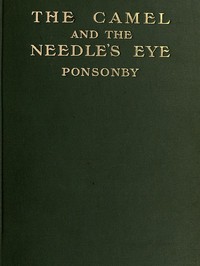
The Camel and the Needle's Eye — Context and Discussion can be approached with a clearer sense of reading commitment from its source measurements: 40,220 words, 2 hr 55 min estimated reading time, and 15 detected text sections.
The text analysis averages about 27.6 words per sentence, while the detected sections provide another way to judge how the source is divided.
Project Gutenberg metadata also associates the work with “Wealth,” connecting these edition facts with the source record’s subject description.
Explore this collection
These alternatives are selected using recorded categories and estimated reading time.
About 178 minutes
Ethics
40,772 recorded words. 3 minutes difference from this book's estimate.
View Gutenberg source #10714About 178 minutes
Ethics
40,791 recorded words. 3 minutes difference from this book's estimate.
View Gutenberg source #33178About 182 minutes
Ethics
41,841 recorded words. 7 minutes difference from this book's estimate.
View Gutenberg source #64882Search stored excerpts and compare books → Choose by your preferences →
Choices use stored catalog measurements. Estimates vary with reading speed. A shared category is a catalog label, not a claim that two books have the same argument or literary quality.
Search reads excerpt text stored with this catalog and links to its associated Gutenberg record. The connection is stored in the site database; this tool does not recheck that every excerpt is word-for-word identical to that external record. Excerpt search does not cover every chapter and does not verify historical publication dates.
Catalog snapshot checked: 2026-09-25. Coverage: 92 public books, 92 available source excerpts.
Calculated from edition completeness, EPUB availability, text structure and catalogue metadata. Not a user rating.
Total of 100 points, scaled to a 2.5-5.0 range. Editions with an empty description or a missing EPUB file are not scored.
Public-domain source text
The source text is kept in the dedicated reader, separate from this catalogue record and its commentary.
Arthur Ponsonby, writing as Thomas Clune, opens The Camel and the Needle's Eye with a direct moral challenge: extreme wealth is not a reward but an excessive burden. The book's subtitle, 'Spiritual Perfection,' signals its ethical rather than economic focus. Ponsonby, a Liberal MP, structures his argument as a series of chapters targeting specific aspects of rich life—from landed estates to business practices—each dissected with a blend of reasoned critique and rhetorical force.
In Chapter VI, Ponsonby contrasts two competing ideals in commerce: the drive to maximize profit versus the ambition to produce the best goods under the best conditions. He argues that the money-making ideal predominates, leading to tricks like 'extensive and sensational advertisement' over slower improvements in production and labor conditions. The talents rewarded are 'astute business capacity and cunning'—qualities he deems inferior. Ponsonby contends that personal enrichment constitutes 'the chief deterrent to permanently successful commercial enterprise,' a claim he supports by tracing the decline of businesses passed to sons educated at public schools and universities, who lack technical training and mistakenly believe money alone can save a failing concern.
Ponsonby repeatedly insists that great riches impose 'a responsibility which no living being is capable of discharging.' This theme recurs across chapters: wealth does not minister to happiness, and its accumulation creates a dis-sympathy between rich and poor. The catalog subjects—wealth and its moral aspects—are directly addressed, but the excerpts show Ponsonby's method is less abstract philosophy than pointed social observation. He examines the rich man's establishments, servants, luxuries, and even his children's education, arguing that the 'money ideal' infects all classes, including the poor who aspire to it. The interdependence of riches and poverty is a central premise, though the excerpts do not reveal whether Ponsonby offers concrete policy solutions or remains in the realm of moral exhortation.
The book's table of contents reveals a systematic progression: from defining the problem (Chapter I) to analyzing the rich man's life in detail (Chapters III–VI) and finally to the 'problem of riches' (Chapter VIII). Ponsonby adopts a dialogic form—the original edition was subtitled 'A Dialogue'—though the excerpts show a monologic, essayistic voice. He frequently uses rhetorical questions and direct address ('let us remember once more the main premises of our contention'). The tone is earnest and reformist, aiming to 'rationalise' the desire for money rather than eliminate it. Notably, the excerpts contain no statistical data or economic analysis; the argument rests on moral reasoning and illustrative examples, such as the failed business heir. Readers should expect a work of ethical persuasion, not empirical sociology.
Ponsonby's book is best approached as a period piece of Edwardian social criticism, reflecting the anxieties of a Liberal politician about the moral costs of industrial capitalism. Its value lies less in original economic insight than in its clear articulation of a viewpoint that saw wealth as a spiritual and social liability. Readers interested in the history of anti-materialist thought or the ethical debates surrounding the British aristocracy before World War I will find it a concise and pointed document.
That rain fell as Ponsonby’s dialogue did, unhurried and sharp. His quiet argument—wealth as a weight, not a gift—stayed with me past the final page. Somehow, I reached for another volume on the shelf, and found the same sober thread: how our inner lives must be tended before society’s. The Task of Social Hygiene — Text and Context felt like a hand extended in that grey light.
Capture what you thought, learned, and would like to remember.