About 537 minutes
The Task of Social Hygiene — Text and Context
Ethics
123,384 recorded words. 13 minutes difference from this book's estimate.
View Gutenberg source #22090
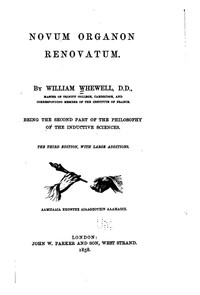
Novum organon renovatum Being the second part of the philosophy of the inductive sciences — Background and Themes can be approached with a clearer sense of reading commitment from its source measurements: 126,366 words, 9 hr 10 min estimated reading time, and 36 detected text sections.
The text analysis averages about 28.4 words per sentence, while the detected sections provide another way to judge how the source is divided.
Project Gutenberg metadata also associates the work with “Science -- Philosophy,” connecting these edition facts with the source record’s subject description.
Explore this collection
These alternatives are selected using recorded categories and estimated reading time.
About 537 minutes
Ethics
123,384 recorded words. 13 minutes difference from this book's estimate.
View Gutenberg source #22090About 589 minutes
Ethics
135,467 recorded words. 39 minutes difference from this book's estimate.
View Gutenberg source #56822About 590 minutes
Ethics
135,471 recorded words. 40 minutes difference from this book's estimate.
View Gutenberg source #46884Search stored excerpts and compare books → Choose by your preferences →
Choices use stored catalog measurements. Estimates vary with reading speed. A shared category is a catalog label, not a claim that two books have the same argument or literary quality.
Search reads excerpt text stored with this catalog and links to its associated Gutenberg record. The connection is stored in the site database; this tool does not recheck that every excerpt is word-for-word identical to that external record. Excerpt search does not cover every chapter and does not verify historical publication dates.
Catalog snapshot checked: 2026-09-25. Coverage: 92 public books, 92 available source excerpts.
Calculated from edition completeness, EPUB availability, text structure and catalogue metadata. Not a user rating.
Total of 100 points, scaled to a 2.5-5.0 range. Editions with an empty description or a missing EPUB file are not scored.
Public-domain source text
The source text is kept in the dedicated reader, separate from this catalogue record and its commentary.
Whewell opens his Novum Organon Renovatum by declaring that Bacon's original organon, however sagacious, is now “practically useless” because its precepts were derived from conjecture rather than from the actual progress of science. The book thus sets out to renovate the inductive method by examining how sciences have actually been constructed, using historical examples rather than a priori maxims.
The work is the second part of Whewell's Philosophy of the Inductive Sciences, and it systematically breaks down induction into three steps: selection of a fundamental idea, construction of a conception, and determination of magnitude. Whewell illustrates these steps with concrete cases, such as the analysis of a star's motion into a formula involving time and its square.
Whewell positions his project explicitly as a successor to Bacon's Novum Organon. He acknowledges Bacon's “broad announcement” of inductive generalization, but argues that Bacon could only “divine how sciences might be constructed,” whereas the nineteenth-century philosopher can “trace, in their history, how their construction has taken place.” This historical turn is central: Whewell insists that the actual record of scientific discovery—from the Chaldean prediction of eclipses to the mathematical analysis of celestial motions—provides instruction that Bacon's conjectures could not.
The preface frames the work as a response to a double gap: Bacon's particular precepts “failed in his hands,” and even if they had succeeded, they would now need renovation. Whewell thus treats the history of science as a laboratory for methodological reflection, not as a mere chronicle of achievements.
Whewell distills induction into three operations: the Selection of the Idea, the Construction of the Conception, and the Determination of the Magnitude. He rephrases these in mathematical terms as the Selection of the Independent Variable, the Construction of the Formula, and the Determination of the Coefficients. The example of a star's motion—observed displacements of 3, 8, and 15 minutes over three years—shows how these steps work in practice: the astronomer selects time as the independent variable, recognizes that the motion follows a quadratic formula at + bt², and then solves for the coefficients a = 2 and b = 1.
This example is not merely illustrative; it reveals Whewell's conviction that induction is a process of quantification and mathematization. The three steps correspond to a movement from vague observation to precise law, and Whewell insists that each step can be promoted by methodical suggestions—though he admits that the first step, the selection of the idea, is the one “in which rules can least aid us.”
Whewell emphasizes that the most critical moment in induction is the detection of the “connecting idea” that transforms a jumble of facts into a coherent system. He contrasts the pre-scientific view of eclipses as “indications of a supernatural will” with the Chaldean discovery that eclipses recur after eighteen-year cycles—a discovery that consisted in selecting “the idea of time, simply, as that to which these events were to be referred.” Once the idea is caught, the facts appear ordered; before it, they seem hopelessly confused.
This epistemological point is central to Whewell's philosophy: the mind does not passively receive data but actively supplies the ideas (such as time, space, cause) that give facts their meaning. The Novum Organon Renovatum thus argues for a kind of Kantian framework applied to the history of science, where the progress of knowledge is a progressive clarification of the fundamental ideas that structure experience.
Whewell's renovation of Bacon is not a rejection but a historical deepening. Readers will find that the book's value lies less in its prescriptive rules than in its detailed dissection of how scientific reasoning actually proceeds—from the selection of an idea to the calculation of a coefficient. The work rewards those who read it alongside the history of the sciences it invokes, from astronomy to optics, and who attend to Whewell's own terminology: idea, conception, magnitude, independent variable, formula, coefficient. These terms are not jargon but the very tools Whewell offers for understanding the growth of knowledge.
There’s something about Whewell’s quiet insistence that discovery arrives through patient, careful naming—how we shape ideas by giving them form. It left me thinking about how joy, too, is a kind of measurement, a deliberate attention to what glimmers. I found that same lingering warmth in The Joyful Wisdom ("La Gaya Scienza") Complete Works, Volume Ten — Story, Setting & Ideas, almost like a gentle echo of that same slow wonder.
Use these questions to collect your thoughts before moving on.